
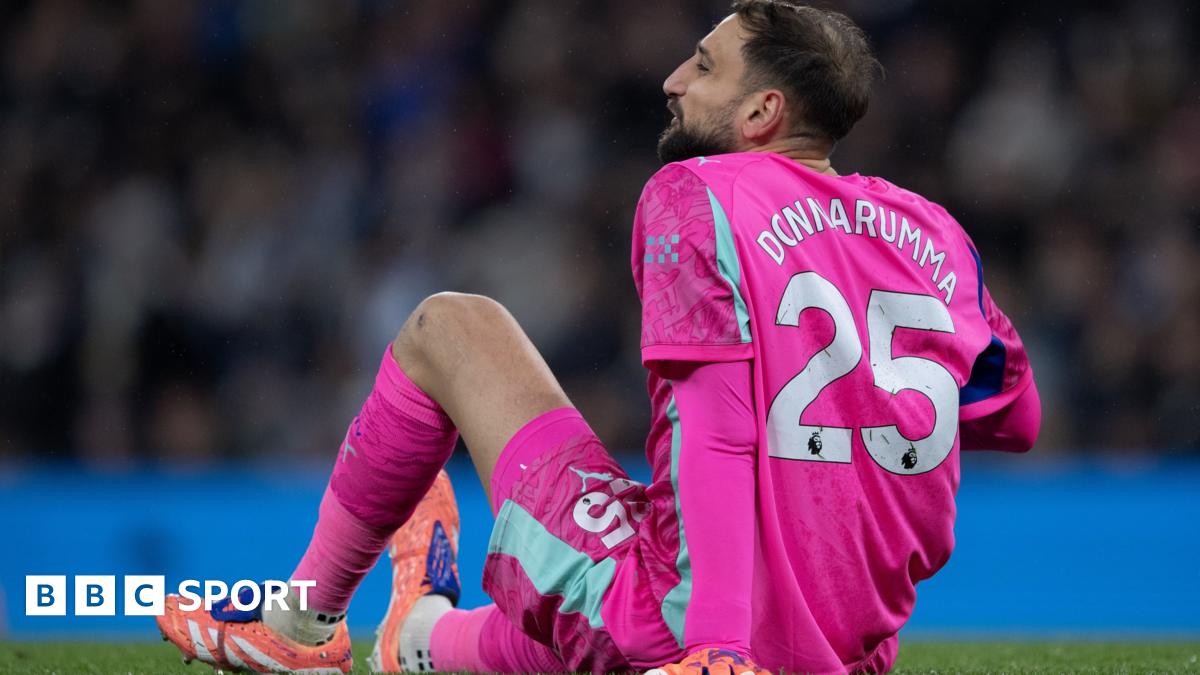
BBC HomepageSkip to contentAccessibility HelpYour accountHomeNewsSportBusinessTechnologyHealthCultureArtsTravelEarthAudioVideoLiveMore menuMore menuSearch BBCHomeNewsSportBusinessTechnologyHealthCultureArtsTravelEarthAudioVideoLiveClose menu BBC SportMenuHomeWorld CupFootballCricketFormula 1Rugby UTennisGolfCyclingAthleticsMoreA-Z SportsAmerican FootballAthleticsBasketballBoxingCricketCyclingDartsDisability SportFootballFormula 1Gaelic GamesGolfGymnasticsHorse RacingMixed Martial ArtsMotorsportNetballOlympic SportsRugby LeagueRugby UnionSnookerSwimmingTennisFull Sports A-ZMore from SportEnglandScotlandWalesNorthern IrelandNews FeedsHelp & FAQsFIFA World CupGroups & ScheduleScores & FixturesTablesTop ScorersGoalkeeper tactical timeouts to be banned at World CupImage source, Getty ImagesImage caption, Leeds United boss Daniel Farke accused Manchester City goalkeeper Gianluigi Donnarumma of feigning injury during their Premier League game Football issues correspondentPublished5 hours agoPlayers at the 2026 World Cup will be stopped from going to the technical area to talk to coaches when goalkeepers are injured, Fifa referees' chief Pierluigi Collina has revealed. The International Football Association Board (Ifab) has also approved a request to change video assistant referee (VAR) protocol to allow reviews of attacking fouls that happen before the ball is in play. The 'goalkeeper tactical timeout' has become a hot topic in recent years. It is used by a manager to get new instructions to his players, or to impact the momentum of the opposition. In November, Leeds United boss Daniel Farke accused Manchester City goalkeeper Gianluigi Donnarumma of feigning injury to "bend the rules" and break up play. The goalkeeper sits on the turf and signals for the physio, the other players rush to the technical area for a team talk, then as soon as the coach has delivered his instructions, the keeper simply gets up to play on. The Ifab has been looking at the issue, but no law change has been agreed. Leagues have been invited to hold a series of trials throughout the 2026-27 season to find a solution. The National Women's Soccer League (NWSL) - the women's professional league in the United States - introduced its own temporary measure earlier this year. If a goalkeeper is injured, the players of both teams must stay where they are or gather in the centre circle. Fifa will apply the same logic as the NWSL and prevent players from going to the touchline. But this only tackles part of the problem, as it will not stop the tactic being used simply to break up the momentum of the other team. Collina said all nations should be aware this is now not permitted. "We had a workshop with all the coaches of all the 48 teams and we told them that referees will be proactive," Collina said. "They will not allow the two teams to go to the benches when a goalkeeper is lying on the ground injured. "The goalkeeper has the right to be injured, but the players do not have the right to leave the field of play to have a sort of timeout with their respective coaches." The effectiveness of the measure at the World Cup is open to debate, as there will be a three-minute hydration break in each half, creating a natural timeout for coaches. The officials will be responsible for enforcing the rule but Collina said there will be no yellow cards or disciplinary action for players who do try to go over and speak to the coach. "It's quite weird that there really is only the referee, the physio and the goalkeeper on the field play," Collina added. "All the other players leave the pitch, and it is not good." To play this video you need to enable JavaScript in your browser.This video can not be played Image source, Getty ImagesImage caption, Under Pierluigi Collina's plans, the VAR would be able to disallow England's goal which angered the Uruguay players so greatly Collina asked for protocol to be updated so the VAR could step in if a foul occurred before the ball was in play. There have been several examples, such as a goal scored by England in their 1-1 draw against Uruguay at Wembley in March. Cole Palmer delivered a corner into the area, but before the ball was kicked Adam Wharton blocked the run of Jose Maria Gimenez. That allowed the ball to run through to Harvey Barnes, who saw his effort saved by Fernando Muslera, and Ben White tapped in from close range. VAR protocol did not previously allow a review for a foul before a corner has been taken, but the Italian asked Ifab for permission to change this. The Ifab has now accepted the request, and says that any foul before the ball is in play that has a direct impact can be reviewed. This will apply to a goal, penalty kick or disciplinary sanction which happens on a corner or free-kick The measure will be applied for the World Cup and reassessed after the tournament. It means that for the England goal, the VAR would be able to suggest a retake of the corner because of the foul by Wharton on Gimenez. "We think this is very unfair, that the goal is given when the defender is prevented from being able to defend," Collina said. "A clear, illegal block made by an attacker. The only objective was to prevent the defender from being able to defend on his opponent. "We are very confident to receive a clarification from the Ifab before the World Cup, saying that the VAR can intervene just before the ball is in play. We are convinced that nobody can object." This will only apply to attacking fouls, and not to defensive fouls for holding or pulling.
Original Source: BBC Sport


0 Comments