
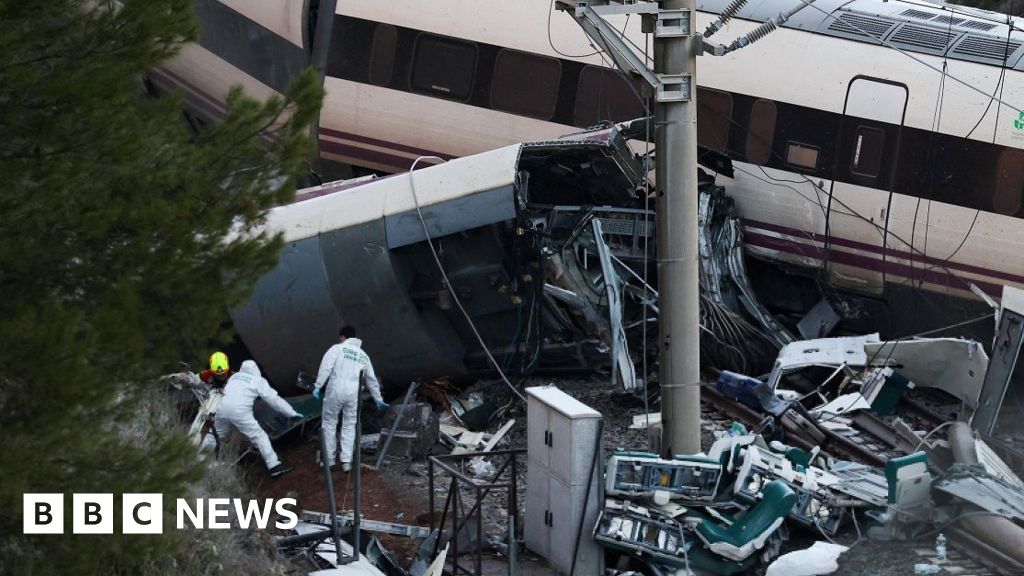
Authorities say the twisted train wreckage makes it difficult to recover people trapped inside.
Watch LiveBritish Broadcasting CorporationHomeNewsSportBusinessInnovationHealthCultureArtsTravelEarthAudioVideoLiveDocumentariesHomeNewsIsrael-Gaza WarWar in UkraineUS & CanadaUKUK PoliticsEnglandN. IrelandN. Ireland PoliticsScotlandScotland PoliticsWalesWales PoliticsAfricaAsiaChinaIndiaAustraliaEuropeLatin AmericaMiddle EastIn PicturesBBC InDepthBBC VerifySportBusinessExecutive LoungeTechnology of BusinessFuture of BusinessInnovationWatch DocumentariesTechnologyScienceArtificial IntelligenceAI v the MindHealthWatch DocumentariesCultureWatch DocumentariesFilm & TVMusicArt & DesignStyleBooksEntertainment NewsArtsWatch DocumentariesArts in MotionTravelWatch DocumentariesDestinationsAfricaAntarcticaAsiaAustralia and PacificCaribbean & BermudaCentral AmericaEuropeMiddle EastNorth AmericaSouth AmericaWorld’s TableCulture & ExperiencesAdventuresThe SpeciaListEarthWatch DocumentariesNatural WondersWeather & ScienceClimate SolutionsSustainable BusinessGreen LivingAudioPodcast CategoriesRadioAudio FAQsVideoWatch DocumentariesBBC MaestroDiscover the WorldLiveLive NewsLive SportDocumentariesHomeNewsSportBusinessInnovationHealthCultureArtsTravelEarthAudioVideoLiveDocumentariesWeatherNewslettersWatch LiveSpain train crash recovery continues as investigators probe 'gap' in rail57 minutes agoShareSaveTom McArthurShareSaveWatch: At the scene of Spain's worst rail disaster in over a decadeHeavy machinery is being used to assist in the recovery following a two-train crash in southern Spain which killed at least 41 people.
Rescuers worked through a second night as more bodies are feared to be trapped in the wreckage.
More than 120 people were injured when carriages on a Madrid-bound train derailed and crossed over to the opposite tracks, hitting an oncoming train in Adamuz on Sunday evening.
A faulty or damaged weld on a rail is being investigated as a factor in the crash, Spanish media report.
Prime Minister Pedro Sanchez has cancelled his planned trip to the World Economic Forum in Davos, pledging to get to the bottom of Spain's worst train disaster in more than a decade.
Spain's King Felipe and Queen Letizia will visit the site later on Tuesday.
Three days of national mourning have been announced.
Transport Minister Óscar Puente said the death toll "is not yet final".
Puente said the investigation could take at least a month, describing the incident as "extremely strange".
Spanish media report that a 30cm gap in one of the rails is the current focus of the investigation.
Technicians told the El Mundo newspaper that a "bad" or "deteriorated" weld was "more than likely" the cause for the derailment.
Ignacio Barron, head of Spain's Commission of Investigation of Rail Accidents (CIAF), said on RTVE: "What always plays a part in a derailment is the interaction between the track and the vehicle, and that is what the commission is currently [looking into]."
However, Spain's El País newspaper reports that it was not clear whether the fault was a cause or a result of the crash.
On Monday, Renfe President Álvaro Fernández Heredia apparently ruled out "human error", telling RNE programme Las Mañanas that, if "the driver makes a mistake, the system itself corrects it".
Heredia also told RNE that both trains were travelling under the maximum speed limit on the stretch of track where the crash happened.
As the i


0 Comments