
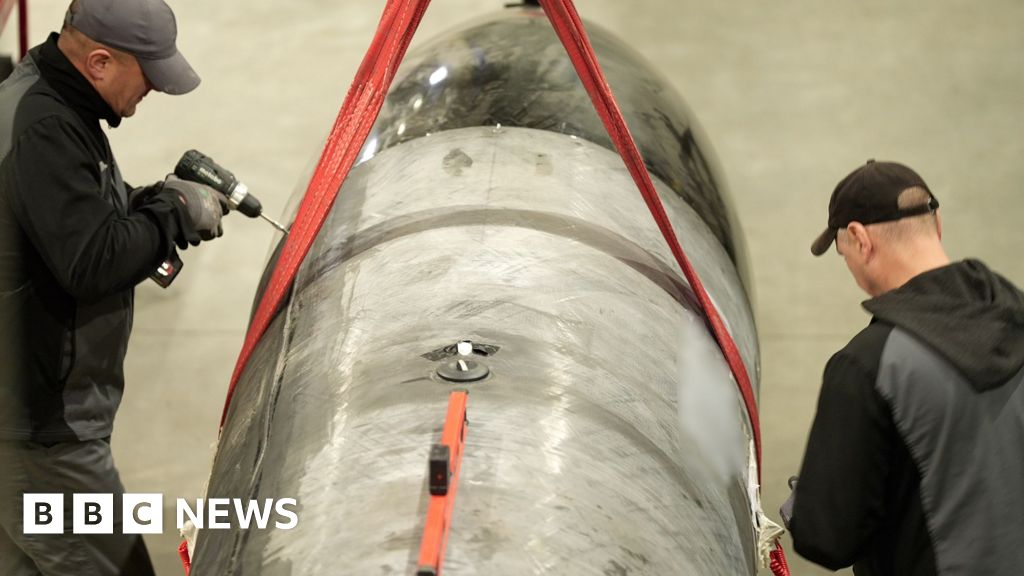
Somewhere in Ukraine, behind blindfolds, switched‑off phones, and sealed doors, a new chapter of modern warfare is being written. In a hidden factory location, Ukraine is quietly but aggressively scaling up its domestic arms industry, producing advanced weapons designed not just to survive the war — but to reshape it.
Visitors are driven in secrecy to the site where Ukraine’s latest cruise missile, known as Flamingo, is being assembled. Security is absolute. Workers’ faces are hidden, architectural details are off‑limits, and filming is tightly controlled. This level of secrecy isn’t paranoia — it’s survival. Two factories linked to Fire Point, the company behind the Flamingo missile, have already been struck by Russian attacks.
Despite constant threats, Ukraine’s arms production is accelerating. President Volodymyr Zelensky says the country now manufactures over half of the weapons used on the front line, with nearly all of its long‑range strike capabilities produced domestically. What began as reliance on aging Soviet stockpiles has transformed into one of the world’s most innovative defence ecosystems, especially in drones, robotics, and now cruise missiles.
The Flamingo missile itself is a symbol of that evolution. Painted black — not pink, as early prototypes were — it’s described by its creators as a weapon that “eats Russian oil.” Visually, it resembles a World War II‑era German V1 rocket: a long tubular body topped with a jet engine. Yet its capabilities are thoroughly modern. With a reported range of up to 3,000 kilometres, it rivals the U.S. Tomahawk missile — a weapon Western allies have been reluctant to supply to Ukraine.
These deep‑strike weapons play a critical role in Ukraine’s strategy. While Russia continues to gain ground along a front line stretching more than 1,000 kilometres, Ukraine is increasingly targeting Russia’s war economy instead of just its troops. Oil refineries, weapons plants, and ammunition depots deep inside Russian territory have become primary targets. Ukraine’s armed forces say these long‑range strikes have already cost Russia more than $21.5 billion this year alone.
At the heart of this push is Fire Point, a defence start‑up that didn’t even exist before Russia’s full‑scale invasion. Today, it produces around 200 drones a day, with its FP1 and FP2 long‑range drones accounting for roughly 60% of Ukraine’s deep‑strike operations. Each drone costs about $50,000 — significantly cheaper than Russia’s Shahed drones, which Moscow continues to mass‑produce.
Fire Point’s leadership reflects Ukraine’s wartime transformation. Its chief technical officer, Iryna Terekh, is just 33 years old and originally trained as an architect. Now, she helps design weapons aimed at dismantling Russia’s military and economic power. Her philosophy is blunt: there is no single “wonder weapon.” Victory, she says, depends on will, intelligence, and tactics.
A major priority for Ukraine’s defence industry is self‑sufficiency. Fire Point deliberately sources most components locally and avoids parts from both China and the United States. The reason is strategic — and political. With U.S. military aid halted under President Donald Trump and future support uncertain, Ukraine does not want its weapons systems dependent on foreign approval or supply chains that could be cut off overnight.
Although Ukraine still relies on external help for funding, intelligence, and targeting, the message from inside its secret factories is clear: dependence is a risk the country can no longer afford. As peace talks continue, many within Ukraine see domestic weapons production not just as a military necessity, but as the only real security guarantee.
For Europe, Ukraine’s leaders believe there is a lesson here — learned the hard way. Ukraine, as one defence official puts it, is a “bloody example” of what happens when a nation is unprepared for war. And if this conflict proves anything, it’s that in modern warfare, resilience, innovation, and the ability to build your own tools may matter just as much as alliances.


0 Comments