
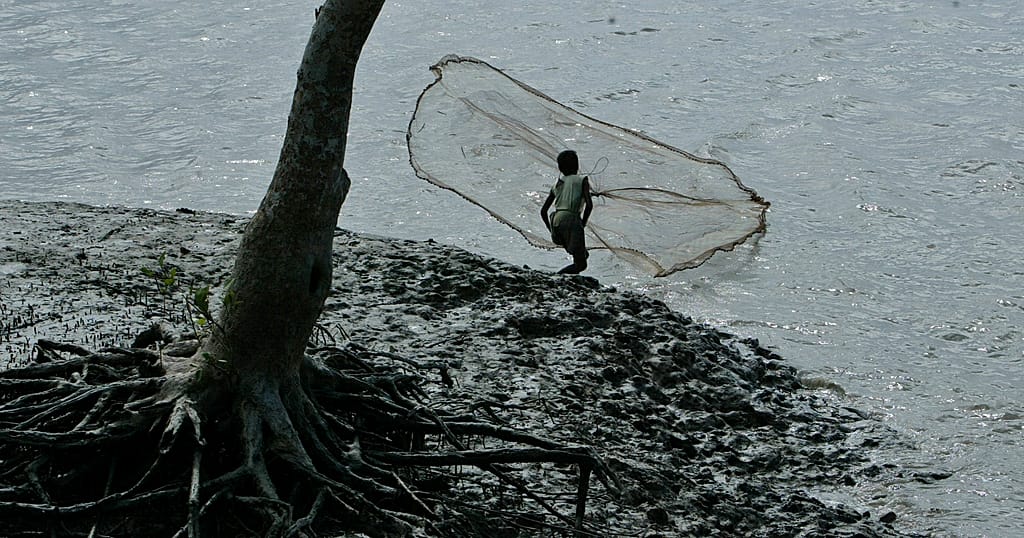
Along the coastal edges of Sierra Leone’s capital, Freetown, a quiet struggle is unfolding inside the mangroves — where livelihood, culture, and nature are all colliding under pressure.
For over 20 years, Millicent Turay has made a living the traditional way: collecting wild oysters from tangled mangrove roots. It’s hard, physical work passed down through generations of women along West Africa’s coastline.
“We learnt how to do it for ourselves… to survive,” she said, speaking while standing in chest-deep muddy water, machete in hand, carefully prying oysters loose.
But survival is getting harder.
A livelihood shaped by water, sweat, and tradition
The work begins at low tide. Women wade barefoot through thick mud and stifling heat, searching for oysters clinging to mangrove roots and rocks. After harvesting, the oysters are steamed using mangrove wood and opened by hand.
In good days, Turay earns about $7 — enough to feed her family and support school fees. It’s not much, but it’s a system that has sustained entire communities for decades.
Oysters remain a staple food across Sierra Leone, commonly eaten in stews, grilled, or dried as snacks. The trade is deeply embedded in coastal life, while men in the community often collect mangrove wood for fuel and construction.
But the forest is disappearing
The real crisis is not just economic — it’s environmental collapse.
Mangrove forests around Freetown are shrinking rapidly due to urban expansion, illegal construction, firewood harvesting, and climate pressure. According to estimates, more than 25% of mangrove cover has disappeared since 1990.
Satellite data from the Aberdeen coastal area shows a sharp decline in mangroves — from 537 hectares in 2017 to 458 hectares by early 2025, according to environmental monitoring groups.
Aminata Koroma, a local resident, described the change plainly:
“This place used to have so many mangroves, with fish and eel.”
Now, buildings push closer to what remains of the wetlands, reshaping the ecosystem that once supported both wildlife and livelihoods.
Fighting back with restoration and innovation
In response, government groups and local communities are beginning restoration efforts, including mangrove replanting projects along the coast.
In Kolleh Town, environmental groups are experimenting with a different approach. Abubakarr Barrie, co-founder of the NGO Nature for Mangroves, is helping build bamboo structures in shallow waters designed to attract oyster growth naturally.
These systems — combined with oyster larvae cultivation — aim to create sustainable “oyster farms” that both restore mangroves and preserve income for local families.
“If we don’t protect our mangroves,” Barrie warned, “millions of coastal residents could lose their livelihoods.”
A future hanging in the balance
What’s happening in Sierra Leone is bigger than oysters. It’s a warning signal — about how fast ecosystems can collapse when pressure builds from every side: population growth, construction, and climate stress.
For women like Millicent Turay, the mangroves are not just trees. They are income, identity, and survival.
And right now, all three are at risk.


0 Comments