
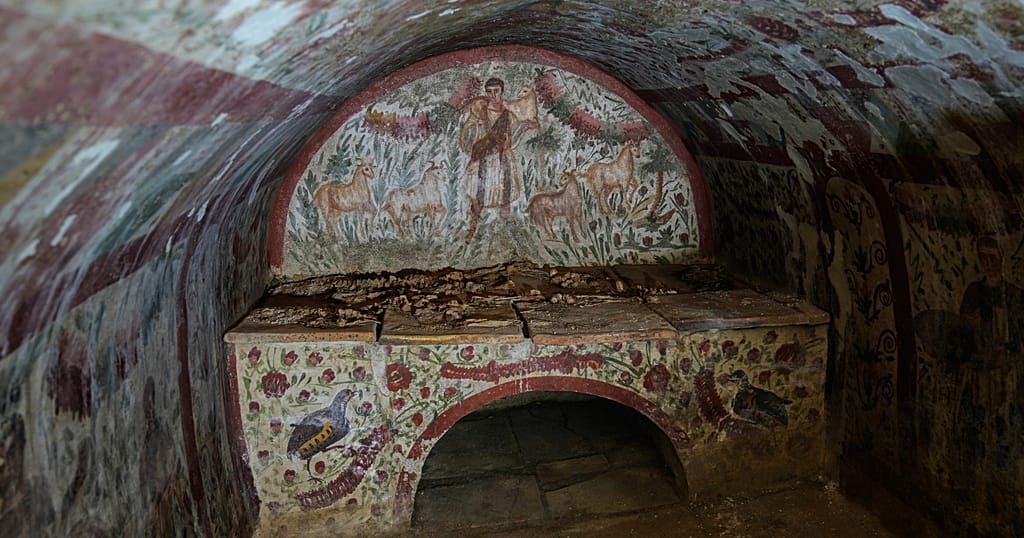
Archaeologists in Turkey have pulled back the curtain on a jaw-dropping piece of early Christian history: a remarkably preserved fresco of Jesus depicted as the “Good Shepherd,” discovered inside an underground tomb near Iznik in northwestern Turkey. This isn’t just another old painting — it’s a heavyweight cultural discovery with serious historical muscle.
The fresco was uncovered in August in the village of Hisardere, close to Iznik, a town etched permanently into Christian history as the site of the Council of Nicaea in A.D. 325, where the Nicene Creed was adopted. That creed, still recited by millions of Christians today, anchors the town’s spiritual legacy — and this new find only deepens its significance.
Dating back to the 3rd century, the tomb comes from a period when Christianity was still underground, literally and socially. Christians faced persecution across the Roman Empire, long before the faith gained official acceptance. Inside this cramped burial chamber, archaeologists found a striking fresco portraying a youthful, clean-shaven Jesus dressed in a Roman toga, carrying a goat across his shoulders — a classic symbol of the Good Shepherd, representing protection, salvation, and divine guidance.
What makes this discovery hit different is its Roman aesthetic. According to researchers, it is one of the very few examples in Anatolia where Jesus is depicted with clear Roman features and attire. Before the cross became Christianity’s dominant symbol, the Good Shepherd motif was the visual language of faith — subtle, symbolic, and powerful. Yet examples from this region are extremely rare, making the Hisardere fresco possibly the best-preserved and most significant of its kind.
Lead archaeologist Gulsen Kutbay described the artwork as potentially “the only example of its kind in Anatolia.” Surrounding the central image are frescoes of birds and plant motifs, alongside portraits of noble men and women attended by slaves — visual storytelling that blends late pagan traditions with emerging Christian beliefs. According to Iznik Museum archaeologist Eren Erten Ertem, the tomb reflects a cultural transition period, showing how early Christians reimagined death and the afterlife in hopeful, affirming terms.
The excavation also revealed the skeletal remains of five individuals. While poor preservation made it impossible to identify two of them, anthropologists confirmed the others included two young adults and a six-month-old infant, offering a poignant glimpse into family and burial practices of the era.
The discovery gained additional global attention following a recent visit to Iznik by Pope Leo XIV, who traveled there to mark the 1,700th anniversary of the Council of Nicaea. During the visit, he prayed alongside Eastern and Western church leaders for renewed Christian unity. Turkish President Recep Tayyip Erdogan presented the pope with a tile artwork inspired by the Good Shepherd fresco, symbolically linking the ancient past with the present.
Anatolia’s role in Christian history runs deep. St. Paul was born in Tarsus, St. John spent his final years in Ephesus, and tradition holds that the Virgin Mary lived her last days nearby. This newly uncovered fresco adds another chapter to that legacy — one painted in quiet faith, artistic courage, and survival under pressure.
Bottom line: this isn’t just archaeology. It’s a time capsule of belief, resilience, and identity — proof that even in the shadows of persecution, early Christians found ways to express hope, meaning, and faith. And centuries later, the walls are still talking.


0 Comments